


Case Study: Road "Tuning" vs Dyno Tuning (Merged)


Newbie
Joined: Aug 2004
Posts: 89
Likes: 0
From: Cartersville, GA
Originally Posted by DynoFlash
The best way for the customer to measure knock would be to log his ignition timing and record how much timing the ecu is pulling then rest the ecu by disconnecting the battery and listen for knock with some snap on chassis ears or with some sort of knock gauge
Have you done this process on the customers car? If not, how can you claim a knock event or that it is going to knock in the future? Are you going on past experiences to think it does or will knock?


Originally Posted by DynoFlash
Got to get back to work - I am now tuning the world's most powerful USA spec Evo IX
Of course I have no clue how MIVEC works so it prob wont make much power
Back to work - very busy


Originally Posted by DynoFlash
Over the years I have seen time and time again - over and over when anyone presses you to the subject and puts you on the spot
You dont explain yourself - you dont discuss the matter
You dont explain yourself - you dont discuss the matter

Al- I believe your answer is on this article http://www.innovatemotorsports.com/resources/rich.php
What I have understood from reading You choose to use the approach of more timing and richer AFR in the peak boost-midrange-peak tq to prevent knock.
Shiv uses the other approach with less timing or 0* and leaner AFRs in the peak boost-midrange-peak tq without knock.
Two methods both valid but if you read the article one is considered better than the other.
What I have understood from reading You choose to use the approach of more timing and richer AFR in the peak boost-midrange-peak tq to prevent knock.
Shiv uses the other approach with less timing or 0* and leaner AFRs in the peak boost-midrange-peak tq without knock.
Two methods both valid but if you read the article one is considered better than the other.

Originally Posted by razorlab
Cool, when you get back from working, could you talk about your AFR curve on this car with a dynoflash? Thanks!
Originally Posted by Warrtalon
He would start by showing how close the measurement points are on the AFR scale, whereas the other dyno sheets from that same dyno day show an AFR scale with 2x-3x the delineation between measurement points. Basically, this tune goes from 11.4 to 10.8 and back to 11.4. I am not saying it's good or designed, but I do know that right at the 6k point, I usually have to add a touch of fuel. Anyway, I don't know if it's a mail-in flash or custom tune, but you can't let the illusion caused by the scaling get you too concerned. If you change the scale, the shape of the AFR curve would appear much less drastic.

and the dynoflash again:
Last edited by razorlab; Jan 12, 2006 at 12:30 PM.
Originally Posted by razorlab
Wrong, all the dyno sheets that did the same RPM pulls scale the same way. This is from the 2nd dyno day not the one you linked up awhile back. here is my chart with the same AFR scale if you want to compare. 2400rpm to 7400rpm
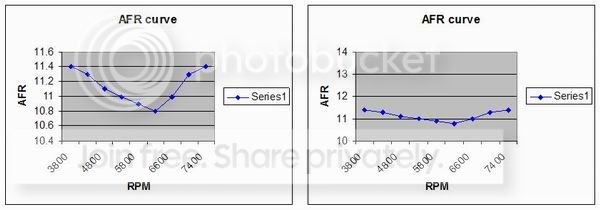
For example:

Last edited by Warrtalon; Jan 12, 2006 at 12:32 PM.
Originally Posted by Warrtalon
Not wrong at all.
 Still doesn't mean the tune is right, why should it bounce all over the place like that? Look at my chart, it stays within .2 AFR the whole way. Al's changes .6 from 3800 to 6200 and again another .6 from 6300 to 7400rpm. Why is that?
The reason why the dynoflash AFR points scale that way on that graph is because the AFR is all over the place so the AFR scale changes accordingly. I believe the mustang dyno charts scale accordingly unlike Dynojets which just show the whole scale. If you notice my AFR chart the points scale is actually tighter. Wonder why?
I am glad we are finally actually having a discussion about tuning.
Last edited by razorlab; Jan 12, 2006 at 12:39 PM.

Thread Starter
Evolved Member
iTrader: (20)
Joined: Mar 2003
Posts: 4,941
Likes: 0
From: Danville/Blackhawk, California
Originally Posted by Jorge T
Al- I believe your answer is on this article http://www.innovatemotorsports.com/resources/rich.php
What I have understood from reading You choose to use the approach of more timing and richer AFR in the peak boost-midrange-peak tq to prevent knock.
Shiv uses the other approach with less timing or 0* and leaner AFRs in the peak boost-midrange-peak tq without knock.
Two methods both valid but if you read the article one is considered better than the other.
What I have understood from reading You choose to use the approach of more timing and richer AFR in the peak boost-midrange-peak tq to prevent knock.
Shiv uses the other approach with less timing or 0* and leaner AFRs in the peak boost-midrange-peak tq without knock.
Two methods both valid but if you read the article one is considered better than the other.

-shiv

Originally Posted by shiv@vishnu
Hey Jorge, that's a great link. I never knew that someone actually addressed the advantages of one approach over the other. Good find
-shiv
-shiv

Originally Posted by razorlab
I realized my mistake before you posted this and edited it. Still doesn't mean the tune is right, why should it bounce all over the place like that? Look at my chart, it stays within .2 AFR the whole way. Al's changes .6 from 3800 to 6200 and again another .6 from 6300 to 7400rpm. Why is that?
The reason why the dynoflash AFR points scale that way on that graph is because the AFR is all over the place so the AFR scale changes accordingly. I believe the mustang dyno charts scale accordingly unlike Dynojets which just show the whole scale. If you notice my AFR chart the points scale is actually tighter. Wonder why?
I am glad we are finally actually having a discussion about tuning.
Still doesn't mean the tune is right, why should it bounce all over the place like that? Look at my chart, it stays within .2 AFR the whole way. Al's changes .6 from 3800 to 6200 and again another .6 from 6300 to 7400rpm. Why is that?The reason why the dynoflash AFR points scale that way on that graph is because the AFR is all over the place so the AFR scale changes accordingly. I believe the mustang dyno charts scale accordingly unlike Dynojets which just show the whole scale. If you notice my AFR chart the points scale is actually tighter. Wonder why?
I am glad we are finally actually having a discussion about tuning.
Originally Posted by DynoFlash
The car when it had my tune was obviously not funtioning properly - my disgnosis was a boost leak
You have got to be kidding me.
Originally Posted by razorlab
I realized my mistake before you posted this and edited it. Still doesn't mean the tune is right, why should it bounce all over the place like that? Look at my chart, it stays within .2 AFR the whole way. Al's changes .6 from 3800 to 6200 and again another .6 from 6300 to 7400rpm. Why is that?
The reason why the dynoflash AFR points scale that way on that graph is because the AFR is all over the place so the AFR scale changes accordingly. I believe the mustang dyno charts scale accordingly unlike Dynojets which just show the whole scale. If you notice my AFR chart the points scale is actually tighter. Wonder why?
I am glad we are finally actually having a discussion about tuning.
Still doesn't mean the tune is right, why should it bounce all over the place like that? Look at my chart, it stays within .2 AFR the whole way. Al's changes .6 from 3800 to 6200 and again another .6 from 6300 to 7400rpm. Why is that?The reason why the dynoflash AFR points scale that way on that graph is because the AFR is all over the place so the AFR scale changes accordingly. I believe the mustang dyno charts scale accordingly unlike Dynojets which just show the whole scale. If you notice my AFR chart the points scale is actually tighter. Wonder why?
I am glad we are finally actually having a discussion about tuning.
Would you say that to consider something the "best" tune, you look just at how flat the AFR curve is? What if there is more fuel required right at 6k for whatever reason? Wouldn't you want to gradually add fuel as it reaches that point, then gradually remove fuel as you move away from that point? Again, not saying one or the other is the "best" just that pointing to the shape of the AFR curve with a non-standard scale is not the best way to form an argument.
Also, I think you have it backwards when explaining the different scaling. The scaling on the Dynoflash chart is the tighter one, because the max and min values are much closer together than the max/min values on the other chart. Notice the 10.8-12.3 vs 11.0-13.3. That's what determines the scaling, not the "quality" of the tune and/or its fluctuations...
Originally Posted by razorlab
what???? This is a whole different car than the evo 9 we discussed earlier. So everytime we post up a dyno and AFR chart from a dynoflash car that doesn't seem right your answer is it has a boost leak?!?!?
You have got to be kidding me.
You have got to be kidding me.
