


Coilover questions


Evolved Member


Joined: Mar 2002
Posts: 1,760
Likes: 22
From: Reading, MA
I repeated this part above just to add a bit more to it - distribution of the lateral load transfer is heavily affected by the drivers input as well. Changing your driving style can affect most of the cars out there and make them to behave on opposite side of what they were doing before. For example, almost any car can be made to push when guided with "proper" inputs!

Nicely said man!!
I repeated this part above just to add a bit more to it - distribution of the lateral load transfer is heavily affected by the drivers input as well. Changing your driving style can affect most of the cars out there and make them to behave on opposite side of what they were doing before. For example, almost any car can be made to push when guided with "proper" inputs!
I repeated this part above just to add a bit more to it - distribution of the lateral load transfer is heavily affected by the drivers input as well. Changing your driving style can affect most of the cars out there and make them to behave on opposite side of what they were doing before. For example, almost any car can be made to push when guided with "proper" inputs!


Evolved Member
Joined: Mar 2002
Posts: 1,760
Likes: 22
From: Reading, MA


Weight transfer doesn't depend on spring rates. Increasing your spring rates doesn't reduce weight transfer, ignoring minor dynamic changes in center of mass height due to suspension articulation.
When you hit the brakes and the car decelerates, load transfer to the front occurs even in completely rigid suspension setups (e.g. karts). For acceleration/braking it's a function of acceleration, wheel base, vehicle mass, and center of mass height. Stiffer springs result in less compression for a given deceleration, but only because the stiffer spring compresses less for a given load. The load transfer is still there even though you don't see as much suspension compression.
This is also incorrect: In steady-state cornering, lateral load transfer is a function of the lateral acceleration, track width, vehicle mass, and center of mass height. You can't reduce that load transfer with stiffer springs or bars (again, ignoring dynamic center of mass height differences).
However, you can influence how that lateral load transfer is distributed between the front and rear wheels by adjusting the relative balance of front and rear roll resistance. Increasing the rear roll resistance relative to the front will make the rear outside tire bear a larger portion of the overall lateral load transfer. The net lateral load transfer isn't changed, though, so that means the front outside tire now bears a smaller portion of that lateral load transfer. The opposite occurs on the other side of the vehicle, with the front inside tire bearing more load and the rear inside bearing less load (or even lifting up in the air).
The Evo is a front-heavy platform, so the front outside tire is naturally heavily loaded in a turn. Increasing rear roll resistance (springs and/or bars) relative to the front is therefore helpful to shift the responsibility for some of that lateral load transfer away from the outside front and toward the outside rear tire. Net grip is increased, not decreased.
TL;DR: Spring rates don't change load transfer. Carefully distributing lateral load transfer between the front and rear outside tires is important for optimizing lateral grip in the front-heavy Evo. Suspensions are difficult.
When you hit the brakes and the car decelerates, load transfer to the front occurs even in completely rigid suspension setups (e.g. karts). For acceleration/braking it's a function of acceleration, wheel base, vehicle mass, and center of mass height. Stiffer springs result in less compression for a given deceleration, but only because the stiffer spring compresses less for a given load. The load transfer is still there even though you don't see as much suspension compression.
This is also incorrect: In steady-state cornering, lateral load transfer is a function of the lateral acceleration, track width, vehicle mass, and center of mass height. You can't reduce that load transfer with stiffer springs or bars (again, ignoring dynamic center of mass height differences).
However, you can influence how that lateral load transfer is distributed between the front and rear wheels by adjusting the relative balance of front and rear roll resistance. Increasing the rear roll resistance relative to the front will make the rear outside tire bear a larger portion of the overall lateral load transfer. The net lateral load transfer isn't changed, though, so that means the front outside tire now bears a smaller portion of that lateral load transfer. The opposite occurs on the other side of the vehicle, with the front inside tire bearing more load and the rear inside bearing less load (or even lifting up in the air).
The Evo is a front-heavy platform, so the front outside tire is naturally heavily loaded in a turn. Increasing rear roll resistance (springs and/or bars) relative to the front is therefore helpful to shift the responsibility for some of that lateral load transfer away from the outside front and toward the outside rear tire. Net grip is increased, not decreased.
TL;DR: Spring rates don't change load transfer. Carefully distributing lateral load transfer between the front and rear outside tires is important for optimizing lateral grip in the front-heavy Evo. Suspensions are difficult.
This where street car experience differs from offroad. You put too stiff of a spring on the front and the car can't dive (especially in braking bumps) on the brakes, you will find a lack of front grip, especially in the mid and rear engine buggies. This is also on a surface where a lot less than adequate traction is available. I literally observed this. We moved to a different spring setup that had a lower rate through the middle of the travel, but also a higher bottoming rate, fixed the valving, and the car worked. It's a much different scenario, but it's where I learned, which is why input is welcome.
Same thing with sway bars. Helped tune a few trophy trucks where ditching the front sway bar and getting proper springs significantly reduced under steer. Put sway bar back on with new springs, understeer. Remove sway bar, reduce understeer. Tells me the swaybar reduces grip.


This where street car experience differs from offroad. You put too stiff of a spring on the front and the car can't dive (especially in braking bumps) on the brakes, you will find a lack of front grip, especially in the mid and rear engine buggies. This is also on a surface where a lot less than adequate traction is available. I literally observed this. We moved to a different spring setup that had a lower rate through the middle of the travel, but also a higher bottoming rate, fixed the valving, and the car worked. It's a much different scenario, but it's where I learned, which is why input is welcome.
There's also something to be said for keeping the suspension on the compliant side over rough surfaces. For your off-road vehicle you want the suspension to soak up bumps under braking, not bounce off of them. With cars on smooth asphalt that's not as much of a concern. It can still be a problem on rougher AX lots, though. Dallas J posted some good videos of stiff springs causing braking problems on rough lots a while ago.
Same thing with sway bars. Helped tune a few trophy trucks where ditching the front sway bar and getting proper springs significantly reduced under steer. Put sway bar back on with new springs, understeer. Remove sway bar, reduce understeer. Tells me the swaybar reduces grip.
We can talk theory all day, but of course what matters is finding a setup that works with your own personal driving style. Just be sure to measure carefully to ensure it's actually faster, because I've been through a few configurations that felt faster but were actually slower for me.


Absorbing bumps generally comes down to valving in the shocks unless spring rates are way way off. Typically, an offroad car with not enough spring will rely to much on the shock, which will result in limited shaft speed (teams have data logged 600-700in/s on well setup vehicles), a very rough ride, and shocks that overheat quickly. Conversely, to much spring and you have to add too much rebound damper, which also overheats the shocks and makes the car feel like a pogo stick. Have to find the medium of springs/valving.
back to the street car discussion. I now have a better perspective in thinking that we are affecting load transfer % vs where I was yesterday.
back to the street car discussion. I now have a better perspective in thinking that we are affecting load transfer % vs where I was yesterday.


Seems like we're heading in the correct direction now.
I'd add that there are really two main factors to keep in mind with spring selection.
-load transfer due to inertial effects of accelerating the mass of the car
and
-load transfer due to road surface imperfections.
What Construct/Dallas said above is applicable to the first item, where springs do not change the amount of load transfer, as long as the road is perfectly flat/smooth.
now consider the load transfer effects due to bumps, whoops, ruts, etc. springs/bars absolutely do impact the amount of load transfer due to those things. lets say as an example you run over a 1" bump with only one tire and you have 1000lb/in wheel rates. that is going to transfer a huge amount of load (give or take 1000 lbs) to the tire that is on the bump even if the car is not accelerating in any direction. obviously not going to be good for maximum grip. go over that same bump with a 100 lb/in wheel rate and it's hardly noticeable.
the optimum compromise between controlling the contact patch geometry with stiff springs/bars and minimizing load transfer due to surface imperfections is going to depend on how smooth the surface is you're driving on and to some extent the speed that you hit those imperfections with. low speed cars on smoothish surface (autox) can run much stiffer than a non-aero road course car, and can run WAY stiffer than something that drives off road.
I'd add that there are really two main factors to keep in mind with spring selection.
-load transfer due to inertial effects of accelerating the mass of the car
and
-load transfer due to road surface imperfections.
What Construct/Dallas said above is applicable to the first item, where springs do not change the amount of load transfer, as long as the road is perfectly flat/smooth.
now consider the load transfer effects due to bumps, whoops, ruts, etc. springs/bars absolutely do impact the amount of load transfer due to those things. lets say as an example you run over a 1" bump with only one tire and you have 1000lb/in wheel rates. that is going to transfer a huge amount of load (give or take 1000 lbs) to the tire that is on the bump even if the car is not accelerating in any direction. obviously not going to be good for maximum grip. go over that same bump with a 100 lb/in wheel rate and it's hardly noticeable.
the optimum compromise between controlling the contact patch geometry with stiff springs/bars and minimizing load transfer due to surface imperfections is going to depend on how smooth the surface is you're driving on and to some extent the speed that you hit those imperfections with. low speed cars on smoothish surface (autox) can run much stiffer than a non-aero road course car, and can run WAY stiffer than something that drives off road.

Originally Posted by Construct
Weight transfer doesn't depend on spring rates. Increasing your spring rates doesn't reduce weight transfer, ignoring minor dynamic changes in center of mass height due to suspension articulation.
When you hit the brakes and the car decelerates, load transfer to the front occurs even in completely rigid suspension setups (e.g. karts). For acceleration/braking it's a function of acceleration, wheel base, vehicle mass, and center of mass height. Stiffer springs result in less compression for a given deceleration, but only because the stiffer spring compresses less for a given load. The load transfer is still there even though you don't see as much suspension compression.This is also incorrect: In steady-state cornering, lateral load transfer is a function of the lateral acceleration, track width, vehicle mass, and center of mass height. You can't reduce that load transfer with stiffer springs or bars (again, ignoring dynamic center of mass height differences).
However, you can influence how that lateral load transfer is distributed between the front and rear wheels by adjusting the relative balance of front and rear roll resistance. Increasing the rear roll resistance relative to the front will make the rear outside tire bear a larger portion of the overall lateral load transfer. The net lateral load transfer isn't changed, though, so that means the front outside tire now bears a smaller portion of that lateral load transfer. The opposite occurs on the other side of the vehicle, with the front inside tire bearing more load and the rear inside bearing less load (or even lifting up in the air).
The Evo is a front-heavy platform, so the front outside tire is naturally heavily loaded in a turn. Increasing rear roll resistance (springs and/or bars) relative to the front is therefore helpful to shift the responsibility for some of that lateral load transfer away from the outside front and toward the outside rear tire. Net grip is increased, not decreased.
TL;DR: Spring rates don't change load transfer. Carefully distributing lateral load transfer between the front and rear outside tires is important for optimizing lateral grip in the front-heavy Evo. Suspensions are difficult.
When you hit the brakes and the car decelerates, load transfer to the front occurs even in completely rigid suspension setups (e.g. karts). For acceleration/braking it's a function of acceleration, wheel base, vehicle mass, and center of mass height. Stiffer springs result in less compression for a given deceleration, but only because the stiffer spring compresses less for a given load. The load transfer is still there even though you don't see as much suspension compression.This is also incorrect: In steady-state cornering, lateral load transfer is a function of the lateral acceleration, track width, vehicle mass, and center of mass height. You can't reduce that load transfer with stiffer springs or bars (again, ignoring dynamic center of mass height differences).
However, you can influence how that lateral load transfer is distributed between the front and rear wheels by adjusting the relative balance of front and rear roll resistance. Increasing the rear roll resistance relative to the front will make the rear outside tire bear a larger portion of the overall lateral load transfer. The net lateral load transfer isn't changed, though, so that means the front outside tire now bears a smaller portion of that lateral load transfer. The opposite occurs on the other side of the vehicle, with the front inside tire bearing more load and the rear inside bearing less load (or even lifting up in the air).
The Evo is a front-heavy platform, so the front outside tire is naturally heavily loaded in a turn. Increasing rear roll resistance (springs and/or bars) relative to the front is therefore helpful to shift the responsibility for some of that lateral load transfer away from the outside front and toward the outside rear tire. Net grip is increased, not decreased.
TL;DR: Spring rates don't change load transfer. Carefully distributing lateral load transfer between the front and rear outside tires is important for optimizing lateral grip in the front-heavy Evo. Suspensions are difficult.
Evolved Member
Joined: Mar 2002
Posts: 1,760
Likes: 22
From: Reading, MA
The major difference comes from the car like a stock EVO, which has extremely soft springs on both ends. Due to the weight of the front end combined with that low roll resistance, body leans so much during the lateral acceleration that geometry of outside wheel is very compromised (aka, positive camber gets to be quite large). Stiffening FSB helps a bit with increase of that resistance, so outside front doesn't gain original amounts of positive camber, which improves grip on that end. The good part of this change it that rear grip is increased as well (see original explanation above), so overall grip is increased on both ends.
Of course, once your FSB gets too strong/big, you will start loosing grip on that end. But I don't think we can get there with stock ride height and OEM springs.

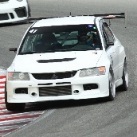
here's my car on ohlins 12k/14k, whiteline front and rear swaybar, RCK, and at 3420 lbs competition weight, on hoosier A7 255/35/18. a bit of trail braking but the right inside tire barely touching the ground.

